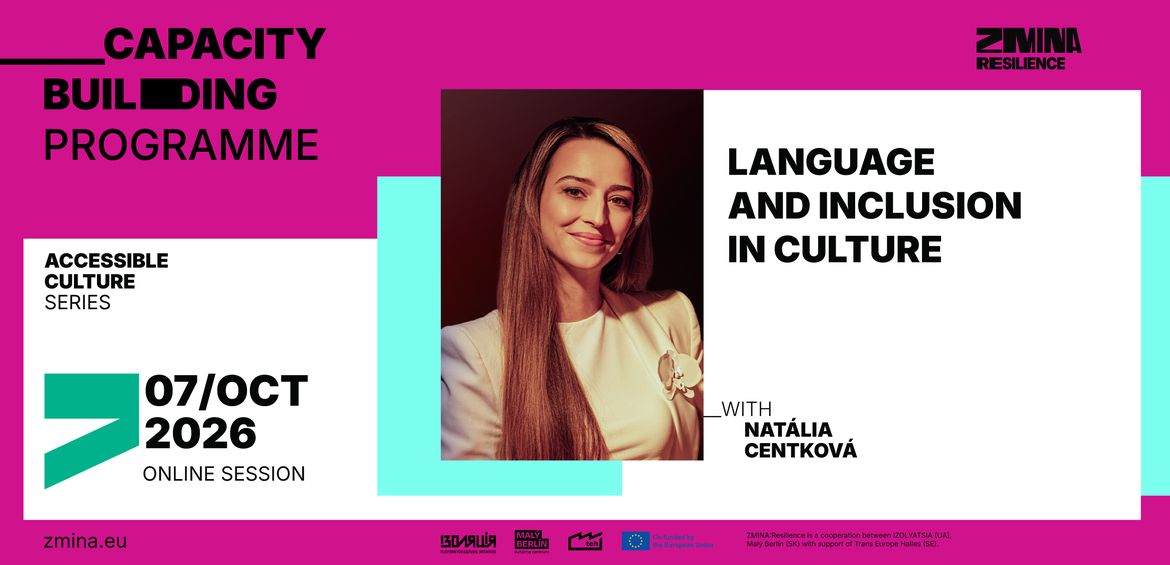
Language and Inclusion in Culture | ZMINA:Resilience capacity building workshop #9
Communication is the foundation of everything cultural organisations do, and it is rarely as simple as it looks. It gets more complicated still when we communicate with and about people with disabilities. Which terms are accepted, and which ones should we avoid? How often do we speak about a group of people without ever speaking to them?
This session treats accessibility as a communication practice rather than a compliance checklist. We begin with the vocabulary — what accessibility, inclusion and disability actually mean, and why the language keeps shifting — and move to the practical side: how cultural organisations address audiences with disabilities, how they describe them in their public communication, and what changes when those audiences are involved from the start rather than consulted at the end. We will also look at the arguments for doing this work at all. Funding conditions and legal obligations — from the UN Convention on the Rights of Persons with Disabilities to the European Accessibility Act and Creative Europe's own accessibility criterion — are part of the picture, but the more durable case is about audiences, teams, and what a cultural institution is for.
The format combines a short theoretical introduction with examples from practice, an interactive exercise, and space for participants to bring their own situations. Perspectives of people with lived experience of disability are part of the session.
Trainer: Natália Centková
Natália Centková works as a Senior Project Manager for CINEFIL at Kino Úsmev, an arthouse cinema in Košice, Slovakia, where she leads both national and international projects. She dedicates herself to inclusion and accessibility for diverse audiences, including people with disabilities and minorities, in the audiovisual industry. She is the co-author of the Caring Cinema website, and developed and co-facilitated training on inclusion and accessibility for European cinema operators. For her efforts in this field, she was named in Forbes Slovakia's 30 Under 30 list, and was selected for the prestigious Community Solutions Fellowship run by the U.S. Department of State. Natália holds a Master of Laws in Public International Law from Leiden University.
Key takeaways:
- Shared vocabulary: the terms behind accessibility, inclusion and disability — and how to keep up as they change.
- Nothing about us without us: what meaningful participation looks like in practice, and where organisations usually get it wrong.
- Lived experience: the session itself includes perspectives from people with lived experience of disability.
- Making the case: arguments you can take to your colleagues and funders.
The training session will be held in English.
Wednesday, 7 October | 13:00 – 15:00 CEST
Registration: https://platform.izolyatsia.org/en/events/language-and-inclusion-in-culture-zminaresilience-capacity-building-workshop-9/
For more information check out zmina.eu
▪ ▪ ▪
ZMINA:Resilience is a cooperation between IZOLYATSIA (UA), Malý Berlín (SK) with support of Trans Europe Halles (SE).
Co-funded by the European Union. Views and opinions expressed are however those of the author(s) only and do not necessarily reflect those of the European Union or European Education and Culture Executive Agency (EACEA). Neither the European Union nor the granting authority can be held responsible for them.