Levels of Belonging. Bohdana Korogod's artistic installation
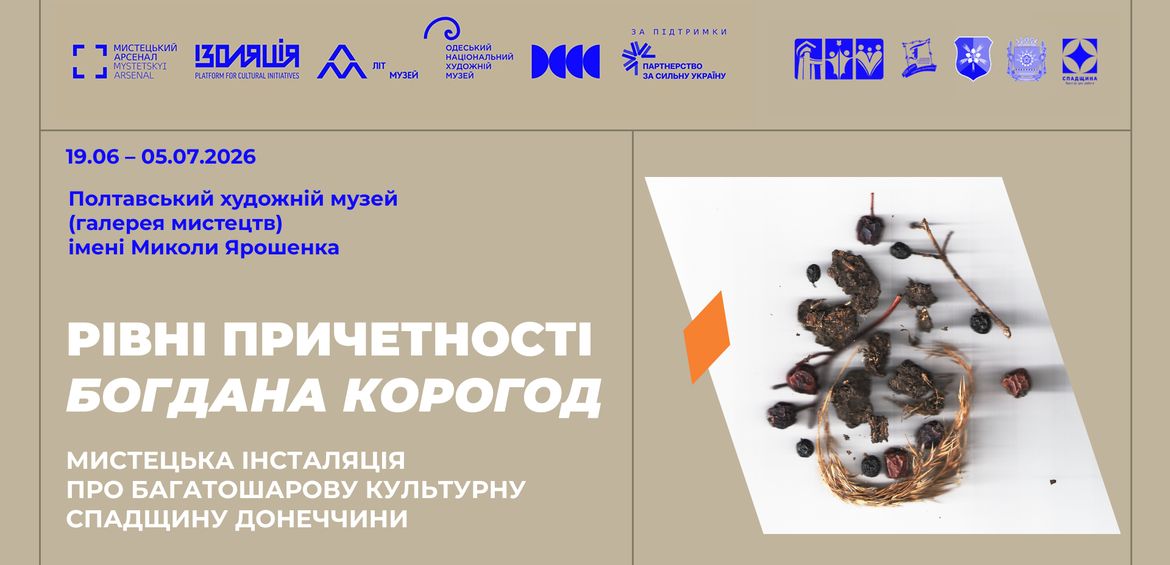
19 June — 5 July 2026
Poltava Art Museum (Gallery of Arts) named after Mykola Yaroshenko (5 Yevropeiska St.)
“Levels of Belonging” is an exploration of the multilayered history and culture of the Donetsk region, as well as the fragmentation of our perceptions of it — particularly of the Kramatorsk district. It was created by artist Bohdana Korogod as part of the residency "Heritage. Practical Work", which is part of the capacity-building and networking programme for local cultural actors "Room for Heritage " — a joint initiative for local cultural practitioners in Ukraine focused on rethinking cultural heritage and strengthening social cohesion.
In the process of working on the project, the artist held meetings with the displaced community of the Kramatorsk district in Poltava: shared readings, writing exercises, and conversations with staff of the IDP Support Centre "MyRazom". She also recorded individual interviews with people from the Donetsk region in Kyiv and Poltava. Important components of the research were expeditions to Sloviansk together with local historian Yevhenia Kaluhina, and to Kramatorsk, where Bohdana familiarised herself with the local history collection of the city's Central Public Library.
During these meetings, conversations, and walks — real and imagined — the artist noticed how a narrative about a place begins with descriptions of landscapes and natural features, moves on to facts about the city or region, and ultimately returns to personal memories and experiences. This very logic became the foundation of the work, which is itself a kind of conversation.
The artist wanted to encapsulate the testimonies, stories, memories, thoughts, legends, and images she had the honour of gathering during the research, which ran from January to May 2026. The composition of this conversation reflects the layers of the earth and our perceptions of it — as a geological structure, ecosystem, resource, home, battlefield, culture. Each of these perceptions forms its own kind of belonging with this land.
The outcome of this research is an installation and an artbook, created in collaboration with havhav bureau.
Like any conversation you join midway, you don't know where it began, and since it is still ongoing — you don't know how it will end. It resembles torn pages from a book that has been stolen or damaged — pages that remain as testimony to its stubborn existence.
This fragmentation is reflected in the installation, which consists of large-format sheets of tracing paper onto which excerpts of texts — presented in full in the artbook — have been rendered in graphite and charcoal. The paper canvases fill the space and lead viewers to the central element of the exhibition — a writing desk. There, they are invited to join the conversation, to become co-authors of the story, and to record their own memories of their Donetsk region.
Bohdana Korogod is an independent author, researcher, and artist working with text, audiovisual, and performative art. She works with themes such as sites of memory, affective urban landscapes, and body memory. She also practises literary translation from English and French.
The project Room for Heritage is a joint initiative for local cultural actors in Ukraine. It focuses on rethinking cultural heritage and strengthening social cohesion. The programme provides mentoring support and grants to help communities overcome challenges caused by the war and create new cultural products.
The capacity building and networking programme for local cultural actors, Room for Heritage is supported by the Partnership Fund for a Resilient Ukraine (PFRU), funded by aid from the governments of Canada, Estonia, Finland, Norway, Sweden, Switzerland, and the United Kingdom. PFRU’s objective is to strengthen Ukraine’s resilience in the face of Russian aggression by delivering essential support to local communities in collaboration with the Ukrainian government, civil society, media, and the private sector.