IZOLYATSIA: from Culture to Torture. Truth Hounds Report

Executive Summary
On 9 June 2014, armed fighters from the Russia-backed 'Donetsk People's Republic' ('DPR') seized the Izoliatsiia site in Donetsk, Ukraine. That seizure twelve years ago set in motion the site's brutal transformation from a prominent cultural centre into a place of violence and repression. In the days that followed, armed groups took control of the complex, vandalised property, and stripped the site of both its artistic purpose and its civic meaning. The seizure marked more than the loss of a cultural institution. It marked the start of Izoliatsiia as a symbol of how occupation authorities can destroy a place of creativity and public life and turn it into an instrument of fear.
This report examines the establishment and operation of the illegal detention facility known as 'Izoliatsiia'. Drawing on 30 survivor testimonies, institutional interviews, prior human rights reporting, documentary material, and open-source investigation, it finds reasonable grounds to conclude that the violence at 'Izoliatsiia' formed part of a systematic attack against a civilian population. The report identifies four crimes that the evidence supports most strongly—imprisonment, enforced disappearance, torture, and sexual violence—and shows how these abuses followed repeated patterns, operated through a structured system of control, and continued over more than a decade. On that basis, the report argues that the available evidence supports a crimes-against-humanity framework.
Ukraine's 2024 legal reforms create an important opening for accountability for crimes committed at 'Izoliatsiia'. By adding crimes against humanity and command responsibility to domestic law, Ukraine has given domestic prosecutors stronger tools to address the long-running, organised pattern of unlawful imprisonment, torture, sexual violence, and other inhumane acts documented at 'Izoliatsiia'. This report therefore serves not only as a record of abuse, but also as a practical resource for future cases. Its legal analysis can help Ukrainian prosecutors assess possible crimes against humanity charges and may also assist prosecutors in other countries considering universal jurisdiction cases where domestic law allows.
The report places 'Izoliatsiia' in the wider context of the international armed conflict in Ukraine. The first chapter traces the origins of the conflict to Russia's armed occupation of Crimea and its decisive military, political, and operational control over armed groups in eastern Ukraine from 2014 onward. It establishes the setting in which 'Izoliatsiia' emerged as a site of detention and violence and situates the crimes committed there within the broader structure of Russian occupation and control.
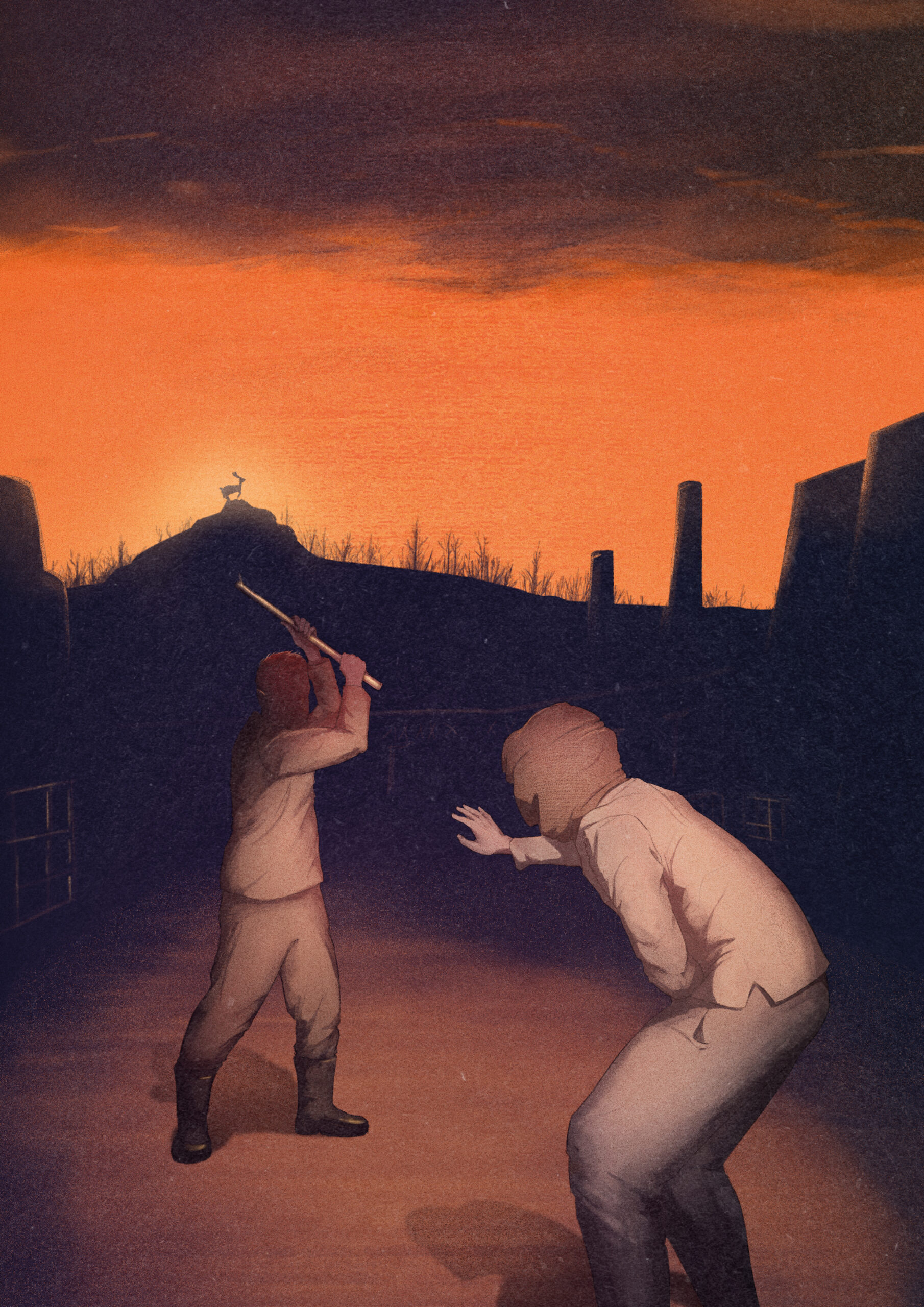
The second chapter explains the historical, cultural, and social transformations of the Izoliatsiia site from 1955, when it began as an insulation materials factory, to later becoming a prominent contemporary art and cultural centre. It then explains how in June 2014 Russian-controlled forces converted the site into a multifunctional military and security facility for illegal detention and how occupation authorities destroyed and repurposed a socially and culturally important space into one of violence, fear and humiliation.
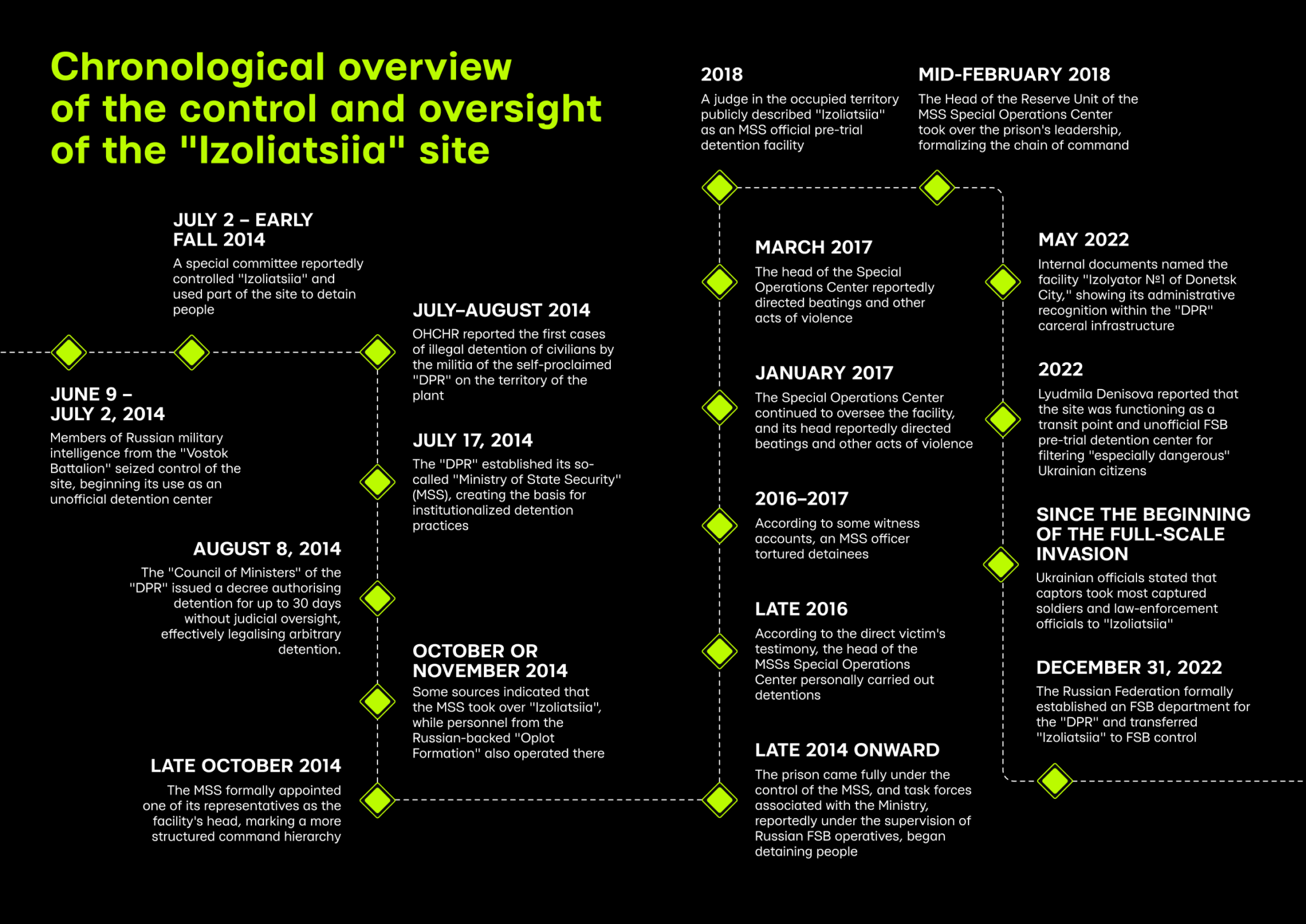
The next chapter maps how official authority over 'Izoliatsiia' evolved after its seizure. It traces control from early armed formations and ad hoc structures to the so-called 'Ministry of State Security' (MSS) of the 'DPR' with further links to the Federal Security Service of the Russian Federation (FSB) and other Russian officials or representatives. The chapter shows that the crimes at 'Izoliatsiia' unfolded inside a system of command, supervision, and institutional support.
The chapter on patterns of violence and their impact on survivors forms the factual core of the report. It documents violence at the time of arrest, abuse during transfers and interrogations, inhumane detention conditions, repeated physical torture, sexual violence, psychological coercion, and the long-term physical and psychological consequences that many survivors carried after release. Survivors describe arrests at gunpoint, beatings, electrocution, stress positions, mock executions, threats against relatives, rape and other forms of sexual violence, forced nudity, severe humiliation, prolonged isolation, denial of medical care, and conditions designed to break them physically and psychologically. The chapter demonstrates repetition, method, and consistency across accounts.
The legal chapter examines how the evidence meets the Rome Statute (RS) requirements for crimes against humanity. It analyzes the contextual elements of Article 7 and applies them to imprisonment, enforced disappearance, torture, and sexual violence. The report finds that, based on available facts, the abuses at 'Izoliatsiia' followed repeated patterns and operated through organised structures. Taken together, the evidence supports the conclusion that these crimes formed part of a widespread or systematic attack against a civilian population and may amount to crimes against humanity.
The chapter on alleged perpetrators builds on that conclusion. It groups alleged perpetrators into three broad categories: guards, wardens, and on-site personnel; personnel from the so-called MSS and 'Ministry of Internal Affairs' (MIA) of the 'DPR'; and FSB personnel and other officials and representatives of the Russian Federation. The chapter shows that the system at 'Izoliatsiia' depended on coordination and control beyond the immediate site of abuse.
The crimes at 'Izoliatsiia' reveal how occupation authorities seized and desecrated a socially and culturally important space to sow terror and repression. The documented violations show why accountability is needed at both the individual and command levels.
Available open-source information, supported by corroborating testimony from former detainees released recently, indicates that the 'Izoliatsiia' complex remained active in 2025. Satellite imagery shows infrastructure work, construction materials, vehicle presence, and signs of heating in the buildings. Although this material does not establish the nature of every activity on the 'Izoliatsiia' site, it strongly suggests that the complex has not been abandoned and that the danger of ongoing abuse remains real.
The findings and analysis presented here underscore the importance of full accountability to deliver justice for survivors, and affirm the Russian Federation's responsibility for grave violations of international humanitarian law. Justice remains essential to exposing, disrupting, and ending the system of repression at 'Izoliatsiia'.
Recommendations
To the Prosecutor General's Office of Ukraine, the Security Service of Ukraine, the National Police of Ukraine, and other competent Ukrainian investigative authorities:
- Enhance investigative efforts into crimes committed at 'Izoliatsiia' as part of an organised system of abuse, and build cases that reflect the full scale and coordinated nature of the conduct, including imprisonment, enforced disappearance, torture, rape, and other forms of sexual violence. Evidence should be assessed with a view to bringing crimes against humanity charges where the facts support them.
- Pursue responsibility across the full chain of command. Investigations should target not only guards and direct perpetrators, but also those who ordered, enabled, coordinated, supervised, or concealed abuses at the facility, including individuals linked to the de facto administration of the site, the MSS and MIA, and Russian officials or representatives associated with its operation and oversight.
- Develop a coordinated prosecutorial strategy for 'Izoliatsiia' and comparable detention sites in occupied territory. That strategy should connect repeated abuses over time, identify recurring perpetrators and structures of control, and use linkage evidence to prove the organised and systematic nature of the crimes.
- Ensure that survivors can participate safely and meaningfully in accountability processes. Strengthen witness protection, trauma-informed interviewing, confidential referral pathways, and long-term psychosocial support, including for survivors of sexual violence and torture.
- Preserve and organise evidence now for future domestic and foreign proceedings, including survivor testimony, open-source material, imagery, records, communications, and evidence relevant to command structures and the cultural property violations.
- Investigate the destruction, looting, seizure, and desecration of cultural objects and the former art space at 'Izoliatsiia' as violations in their own right.
To the Prosecutor General's Office, and international partners providing rule-of-law and accountability assistance to Ukraine:
- Provide specialised support to help Ukrainian prosecutors and investigators build crimes against humanity cases arising from 'Izoliatsiia' and similar detention sites. That support should include sustained training on Article 7 crimes, the contextual elements of crimes against humanity, linkage evidence, modes of liability, and case-building strategies that capture patterns rather than isolated incidents.
- Support multidisciplinary investigation teams that combine prosecutors, investigators, analysts, open-source specialists, psychologists, and experts on conflict-related sexual violence, detention systems, and cultural property to build integrated pattern analysis and survivor-centred investigative practice.
- Expand access to analytical and technical support needed for large-pattern international crimes cases, including tools and personnel able to map perpetrators, timelines, detention structures, chains of command, and recurring methods of abuse over many years.
- Ensure that assistance to Ukrainian prosecutors also covers crimes against cultural property, including documentation standards, evidentiary strategies, and legal pathways for accountability and restitution.
To foreign prosecutors, specialised war crimes units, and national authorities able to exercise universal or other extraterritorial jurisdiction:
- Open or advance structural investigations into crimes committed at 'Izoliatsiia' where domestic law allows for prosecution of torture, enforced disappearance, sexual violence, war crimes, crimes against humanity, or related offences on the basis of universal or other extraterritorial jurisdiction.
- Prioritise cases against suspects who travel, reside, or hold assets abroad, and coordinate closely with Ukrainian authorities and documentation groups to preserve evidence and avoid duplication.
To states supporting accountability efforts in Ukraine, the European Union, the Council of Europe, and other international donors:
- Provide long-term financial, technical, and political support for investigations and prosecutions relating to 'Izoliatsiia' and similar detention sites in Russian-occupied territory. Accountability for crimes against humanity requires sustained institutional backing, beyond short-term project support to Ukraine's justice sector.
- Directly support the specific capacities Ukrainian prosecutors need to bring crimes against humanity cases effectively, including Article 7 expertise, linkage analysis, survivor support, secure evidence systems, and coordination between teams working on detention-related crimes, sexual violence, and cultural property violations.
- Support joint efforts by prosecutors, investigators, and civil society to document and analyse the organised nature of abuse at detention sites in occupied territory, including the role of command structures and the long-term physical and psychological impact on survivors.
To the International Committee of the Red Cross (ICRC) and relevant United Nations bodies:
- Continue to request prompt, regular, and unimpeded access to any detainees held at 'Izoliatsiia' and to the facility itself, and publicly report any denial of such access, in order to increase the potential for scrutiny of ongoing abuses.
To United Nations Educational, Scientific and Cultural Organization (UNESCO):
- Publicly condemn the destruction, looting, and desecration of cultural property at 'Izoliatsiia'.
- Support efforts to document, verify, and preserve evidence relating to artworks, installations, archives, and other cultural objects associated with 'Izoliatsiia' including through records of loss and technical assistance that could support future restitution and accountability efforts.
To non-governmental organisations and academics:
- Continue documenting 'Izoliatsiia' and similar detention sites as organised systems of abuse, including through pattern evidence that can support crimes against humanity charges and cases against those highest in the chain of responsibility.
- Deepen research on conflict-related sexual violence, coercive detention practices, enforced disappearance, torture, and the long-term physical and psychological consequences of abuse in detention in occupied territory.
- Document the cultural dimension of abuses at 'Izoliatsiia' with rigour, including the ideological destruction of Ukrainian art, the seizure or disappearance of cultural objects, and the broader erasure of civic and cultural life under occupation.
- Research the diversity and duration of the consequences of crimes committed by the occupation forces of the Russian Federation on the mental health of survivors.
To organisations supporting survivors:
- Provide sustained, trauma-informed medical, psychological, and legal support to former detainees of 'Izoliatsiia' and their families, including survivors of torture and sexual violence. Help ensure that survivors can engage in documentation and accountability efforts safely, voluntarily, and with appropriate protection against retraumatisation.