The garden of names will be planted. ISOLATION DAY 2026
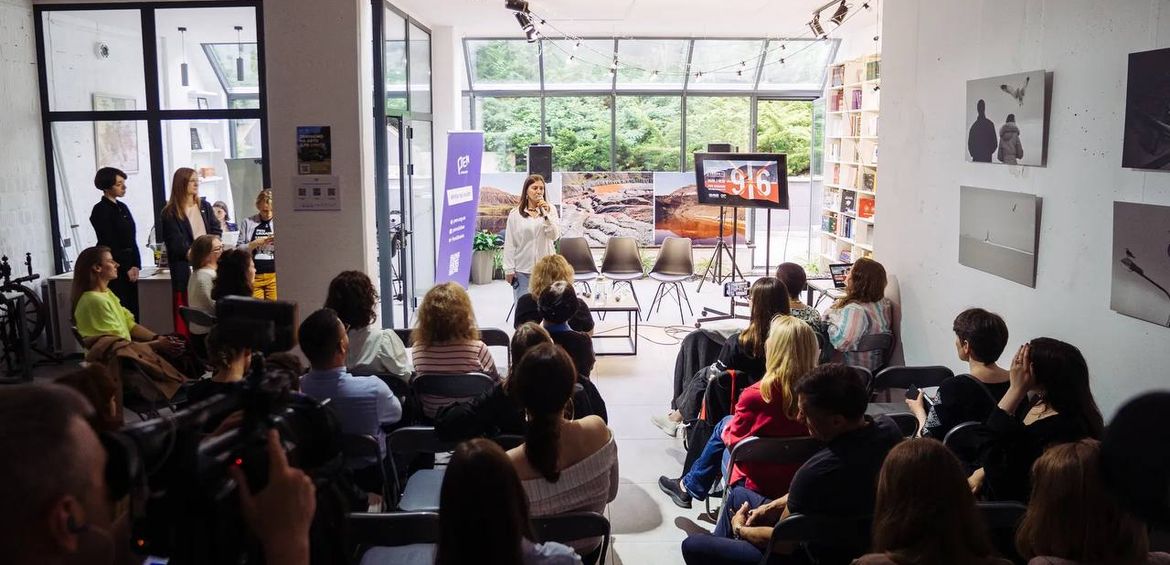
On June 9, 2026, an event that combined art, justice, and living memory took place in the PEN Ukraine space in Kyiv — an evening dedicated to the 12th anniversary of the illegal seizure of the IZOLYATSIA foundation by armed formations of the Russian Federation.
The hall at PEN Ukraine was filled long before the event began. Among the guests were former employees of the foundation, lawyers, writers, journalists, and people who remember IZOLYATSIA as a vibrant cultural space in Donetsk. Against the backdrop of the improvised stage were photo works by Andriy Lohinov from the 2010 residency, part of the project "Monuments of Donbas." These images were captured before the seizure. Now they stand as a document of another time.
"IZOLYATSIA is about the freedom of self-expression, it's about the freedom of art, it's about cultural diversity," said lawyer Volodymyr Yefymenko during the evening. And for this reason, he added, the seizure of this specific space was not a coincidence, but an ideological act.
The evening began with the premiere of a video work by artist Zoya Laktionova titled "Garden of Names," created specifically for this anniversary. The author hails from Mariupol. Some scenes were filmed during her residency in Soledar — a city that has ceased to exist in its former state. A city that first hosted IZOLYATSIA in 2014.
"This idea came to me before IZOLYATSIA reached out to me," Zoya Laktionova shared. "I was thinking about memory when Mariupol was occupied. Along with everything else, the grave of my mother was also occupied. She cannot speak for herself — and for the fact that the Donetsk region was Ukrainian."
In the work, the text speaks of memory, which does not die with a person. Laktionova reinterpreted it as a statement about all the people of the Donetsk region: "As long as I remember this — it is Ukrainian."
The music for the film was composed by Stanislav Ivashchenko, who lived in Donetsk for 20 years. He deliberately refused the sad tonality.
"I immediately recalled the words of Ihor Kozlovsky, after he was released from captivity. When he was asked if he missed the city of Donetsk, he said: 'Sorrow is one of the varieties of neurosis.' This response clarified a lot in my mind," explained Ivashchenko. "I didn't want to write sad music. It simply creates a pure space for your memories — a space where you can recall and transform that into hope."
Curator of the fund Kateryna Filiuk, who presented the work, noted that the footage from Soledar, captured during the residency, is among the few that have survived: "We understand that this is now one of those rare frames left from this city. It is probably even more poignant."
Simultaneously with the artistic premiere, the evening carried an important legal news. On April 29, 2026, the Dnipro District Court of Kyiv completed a 12-year criminal proceeding — and sentenced Roman Lyahin to 15 years in prison for treason, participation in a terrorist organization, changing the borders of Ukraine, and seizing IZOLYATSIA as a war crime.
Lawyer Volodymyr Yefymenko, who has been accompanying the case from the very beginning, called this verdict precedent-setting — and explained why: "This is the first verdict in the history of Ukraine, where the court qualified the seizure of assets and property of enterprises not under a separate article regarding encroachments on property, but specifically as a war crime."
The court applied international humanitarian law and recognized violations of the 1949 Geneva Convention for the Protection of Civilian Persons. It was separately proven that Lyahin, as the head of the so-called Central Election Commission of the "DPR," organized a fictitious "referendum" and "elections" — and the court confirmed that no one actually counted any votes: "The figures provided were simply announced by Moscow."
"This is one of the clusters that will help Ukraine build charges at a future tribunal — similar to the Nuremberg Trials," Yef